
For thousands of Indian students, Britain begins as a destination for a degree — but increasingly, it becomes the starting point of something much bigger.
By Rajeshwari Ghosh (Overseas Correspondent, London)
There was a time when an Indian student travelling to Britain for higher education would have been a “once-in-a-blue-moon” story. Today, it is almost an established part of the British university experience. From London to Edinburgh, Indian students have become one of the most visible international communities across British universities. Indian nationals were the largest group receiving sponsored study visas in the UK in the year ending December 2025, with 95,231 visas granted to main applicants. Around four in five Indian students arriving through this route were coming to study at master’s level, reflecting the particular attraction of Britain’s postgraduate system and its large number of one-year master’s programmes – myself being one of them.
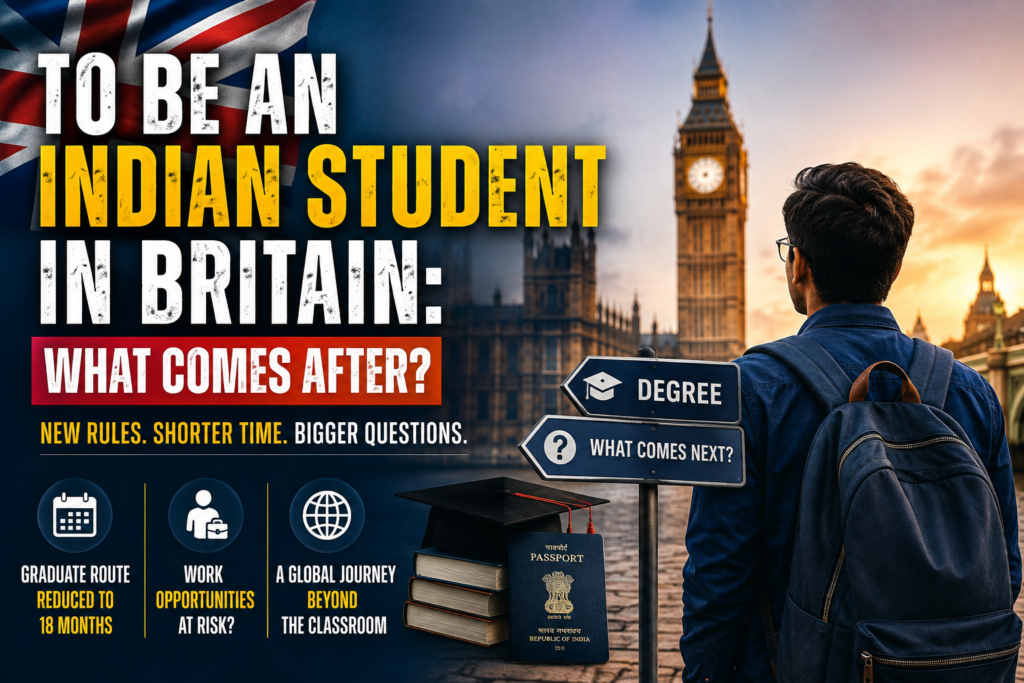
The UK’s Graduate Route allows international graduates to remain in the country after completing an eligible course, giving them the opportunity to work or look for employment without requiring sponsorship immediately after graduation. That opportunity is however about to become considerably shorter, as Home Secretary Shabana Mahmood announced in October 2025 that the Graduate Route would be reduced from two years to 18 months for most graduates, with the change applying to applications made from 1 January 2027.
For me personally, as a postgraduate student in the UK who expects to complete this degree later this year, I will be applying for the Graduate Route in December 2026 and therefore, provided I meet the eligibility requirements, will be among the final group of master’s graduates able to receive the full two-year period. There is a certain irony in beginning a British education at a time when the country is actively reconsidering how long international graduates should be allowed to remain. For students arriving after January 2027, the same qualification will provide 18 months rather than two years to establish themselves in the British labour market.
The effects of this decision will not be limited to Britain itself, as Indian students who remain in the UK become part of a growing professional and social community, while those who eventually return to India take with them British qualifications, international work experience and professional connections. The same pattern is visible elsewhere in Europe, with Germany, France and other countries attracting increasing numbers of Indian students through universities, scholarships and employment opportunities.
Education has therefore become one of the strongest links between India and Europe. A student arriving in Britain may initially be concerned with nothing more than finding accommodation, attending lectures and completing a dissertation, but the consequences of that decision can extend much further, as they eventually become part of an Indian diaspora which continues to grow across European cities.
The Indian student in Britain is therefore no longer simply an international student. They are part of a much larger movement of people, qualifications, skills and ideas between India and Europe. Britain will continue to attract Indian students because of the reputation of its universities and the opportunities offered by its labour market, but the terms on which those students can build their futures are changing. For the generation arriving now, studying in Britain may still open the door. The question is how long they will be given to walk through it.
Indian students in UK , Indian students in Britain, UK Graduate Route, UK student visa 2026 , UK Graduate Visa , Indian students studying abroad , UK education for Indian students, Indian students UK jobspost graduate study in UK , UK immigration rules 2027