
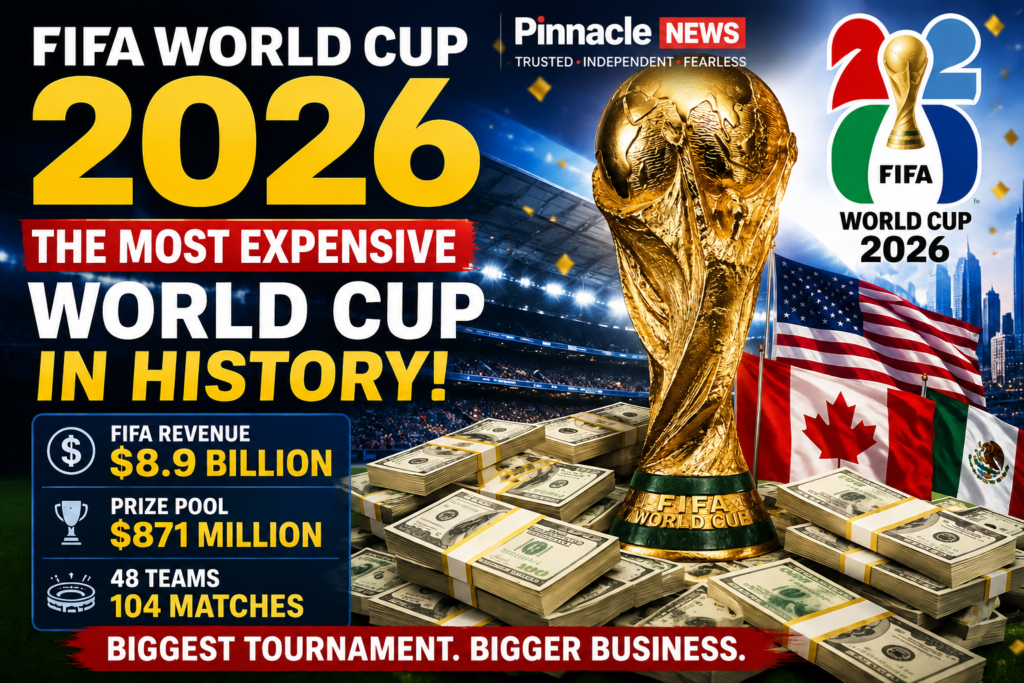
FIFA World Cup 2026 is set to become the richest football tournament in history, with FIFA expecting $8.9 billion in revenue, a record $871 million prize pool, and 48 teams competing across North America.
By Rahul Das ( Spl Football Writer ) :
FIFA World Cup 2026 and all the money involved: A beginner’s guide to the most expensive football tournament in history . FIFA estimates it will earn $8.9 billion in revenue from the tournament alone — meaning this is not just a spectacle, it is a spectacular profit machine.
First, the Big Number :
Let’s start where all good financial stories start — at the top.The FIFA World Cup 2026 has a budget of $3.76 billion, making it the most expensive World Cup in history. FIFA, however, estimates it will earn $8.9 billion in revenue from the tournament alone — meaning this is not just a spectacle, it is a spectacular profit machine. Over the full four-year cycle from 2023 to 2026, FIFA’s total earnings are expected to touch $13 billion. To put that in perspective: the 2022 World Cup in Qatar generated $7 billion in total. The 2026 edition represents a 56% increase on that figure. FIFA has essentially monetised the World Cup the way the NFL monetises the Super Bowl — except the World Cup runs for 39 days across 16 cities in three countries, and the viewership isn’t just America. It’s everyone.
Why Is This One So Much Bigger?
Three reasons, and they compound each other.The first is scale. This is the first World Cup with 48 teams instead of 32, which means 104 matches across 16 host cities instead of 64. More matches mean more broadcast slots, more sponsorship inventory, more tickets to sell, and more hotel rooms to fill. Every number in the commercial machine gets larger.The second is location. The United States is the most commercially saturated sports market in the world. The value of US media rights alone has jumped 94% compared to the 2022 tournament in Qatar. When American broadcasters are bidding, the numbers go up fast. The third is timing. After years of being treated as a secondary sport in North America, football is having a moment. MLS is growing, Messi moved to Miami, and the sport has embedded itself into American sporting culture in a way it hadn’t managed before. FIFA picked the right moment to cash in.
The Opening Act:
Three Ceremonies, One MessageBefore a ball was kicked, FIFA made clear what kind of tournament this would be.There were three opening ceremonies in three cities: Mexico City on June 11, then Toronto and Los Angeles on June 12 — each held 90 minutes before the host nation’s first match, and all three produced by Marco Balich, the creative director behind multiple Olympic Opening Ceremonies. Mexico City was headlined by Shakira and Burna Boy. Joining them at the Estadio Azteca were Alejandro Fernández, Belinda, Danny Ocean, J Balvin, Lila Downs, Los Ángeles Azules, Maná, and Tyla. Toronto got Alanis Morissette and Michael Bublé. Los Angeles got Katy Perry, Future, Anitta, LISA, and Rema.None of this comes free. High-profile performer lineups at sporting events of this scale typically cost tens of millions of dollars in fees, production, staging, and broadcast integration — costs absorbed into that $3.76 billion tournament budget. The ceremonies are not just spectacle; they are the commercial pre-roll for the most watched month of live television on earth.
The Prize Money:
A 65% JumpHere’s where teams and federations pay close attention.The total prize pool for 2026 is $871 million — a 65% jump from the $440 million distributed at the 2022 Qatar tournament. Every team that qualifies is guaranteed at least $12.5 million, and the champion takes home $50 million.On top of that, every qualified nation receives $2.5 million in preparation funding before a ball is even kicked. So even the team that finishes last in the group stage walks away with money.For context on what winning buys you: Argentina received $42 million when they won in 2022. The 2026 winner earns $53.5 million — $11.5 million more. That is not just prize money. That is recruitment leverage, federation infrastructure, youth development, and four years of geopolitical soft power, all delivered in a single cheque.
FIFA World Cup 2026
FIFA revenue 2026
World Cup prize money
FIFA World Cup business
Football economy
FIFA earnings
World Cup 2026 revenue
USA Canada Mexico World Cup
FIFA World Cup prize pool
Biggest World Cup in history