
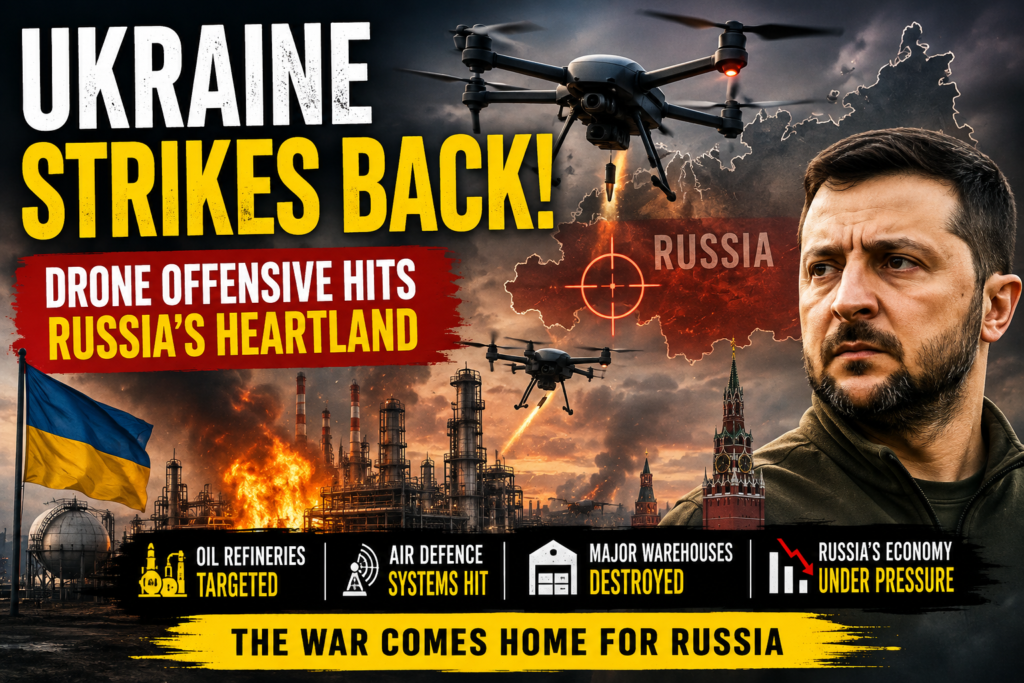
Ukraine is intensifying its drone strikes against Russian oil refineries, air-defence systems and strategic infrastructure. Explore how Zelenskyy’s new drone campaign could affect Russia’s war economy and the future of the Russia-Ukraine war.
By Rajeshwari Ghosh ( Overseas Correspondent, London , UK)
Last Sunday, 9th August, saw President Volodymyr Zelenskyy of Ukraine deliver a rousing speech on X, formerly known as Twitter, thanking every soldier involved in the recent drone strikes launched by Ukraine against Russia. With a rallying battle cry of “Slava Ukraini!” Zelenskyy stated outright that he was taking the war with Russia to where it would be felt in their very home, justifying the move by stating that they “do deliver entirely justified responses, and every Russian strike will be met with [their] response. Today, I thank the Armed Forces and the Security Service of Ukraine – the operation targeting Russian oil refining continues, and they really feel it. Russian anti-aircraft missile systems and radar stations were also hit, and there were our responses targeting Russian…
The statement by Zelenskyy follows the Ministry of Defence of the Russian Federation reporting earlier on Sunday morning that they had shot down 285 Ukrainian drones within the timespan of 8am to 8pm MSK across central and western Russia. Sergei Sobyanin, the Mayor of Moscow even personally took to Telegram to post that their air defence units had successfully intercepted and destroyed 5 Ukrainian drones headed directly towards Moscow. These failed attempts do however pale in comparison to the immense success that Ukraine’s drone strike campaign has been otherwise, because it was just over the past week that they managed to take out over a third of Russia’s total oil refining capacity by attacking – among other facilities – two of their biggest oil refineries in Bashneft-Novoil and Slavneft-Yanos.
At the same time, a different squadron of Ukrainian drones focused their attack on several warehouses owned by Wildberries – the Russian equivalent of Amazon – and succeeded to destroy about 20% of their collective storage, causing estimated financial losses of over 280 billion rubles.
President Zelenskyy has put the entire onus of the destruction caused by these drone strikes on “Russia’s unwillingness to end this war,” and reiterated that Ukraine will continue to engage in active diplomacy by signing new contracts with mediators. Meanwhile, economists have started to predict an oncoming inflation for Russia, which falls in place with Zelenskyy’s attempt to prove to the common people living in Russia that if their leader continues to escalate this war, it will result in dire circumstances at home as well. Civilian casualties have already been reaching extreme highs in Ukraine, with the United Nations recording 1396 deaths in the first half of 2026.
The Ministry of Foreign Affairs in Russia has also countered this report with their own recent civilian death toll of 250 Russian civilians. The numbers appear to be consistent with Moscow launching almost 6 times the average amount of air strikes on Ukraine as compared to Ukrainian drone strikes. This is indeed primarily owing to Russia’s heavy stock of ballistic missiles which Ukraine neither has access to, nor the ability to defend against, due to the recent shortage of US-made Patriot interceptor missiles.
Natia Seskuria, a Senior Research Fellow for Russian and Eurasian Security at RUSI has also made a comment predicting that despite the barrage of attacks and growing discontent among their civilians, Russia is highly unlikely to cease their onslaught against Ukraine, and instead choose to escalate the war even further. As of today, Ukraine’s aerial warfare is expected to continue, and eventual comments and reports of success from President Zelenskyy are both expected and awaited.
( Ukraine drone strikes Russia, Russia Ukraine War 2026, Zelenskyy, Ukraine drone offensive, Russian oil refinery attacks, Russia air defence, Ukraine war, Russia war economy, Ukraine Russia conflict, drone warfare)