
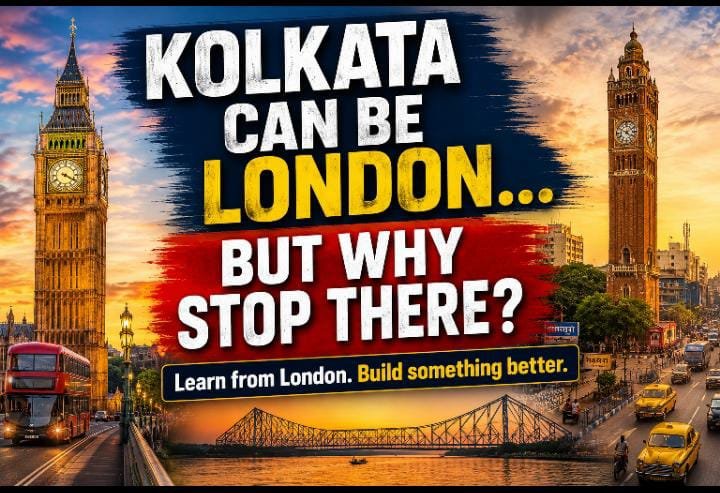
Kolkata has long been called the London of India. But should London be the ultimate benchmark? Explore why Kolkata can learn from London, overcome its shortcomings and become a better global city without losing its unique identity.
By Rajeshwari Ghosh, Overseas Correspondent, London ( pinnaclenews.in)
“Kolkata – the London of India “ – as a journalist who spent a significant part of my life in Kolkata before moving to and establishing myself as a correspondent from London, I personally have memories of “turning Kolkata into London” being used as a slogan from as long as I can remember. The former Chief Minister of West Bengal, Mamata Banerjee, had spoken on several occasions about developing Kolkata along the lines of the capital city of the United Kingdom, most notably through the construction of a replica of London’s Big Ben at the Lake Town crossing on VIP Road in 2015, as part of her broader vision of transforming Kolkata into a more modern and internationally recognisable city.
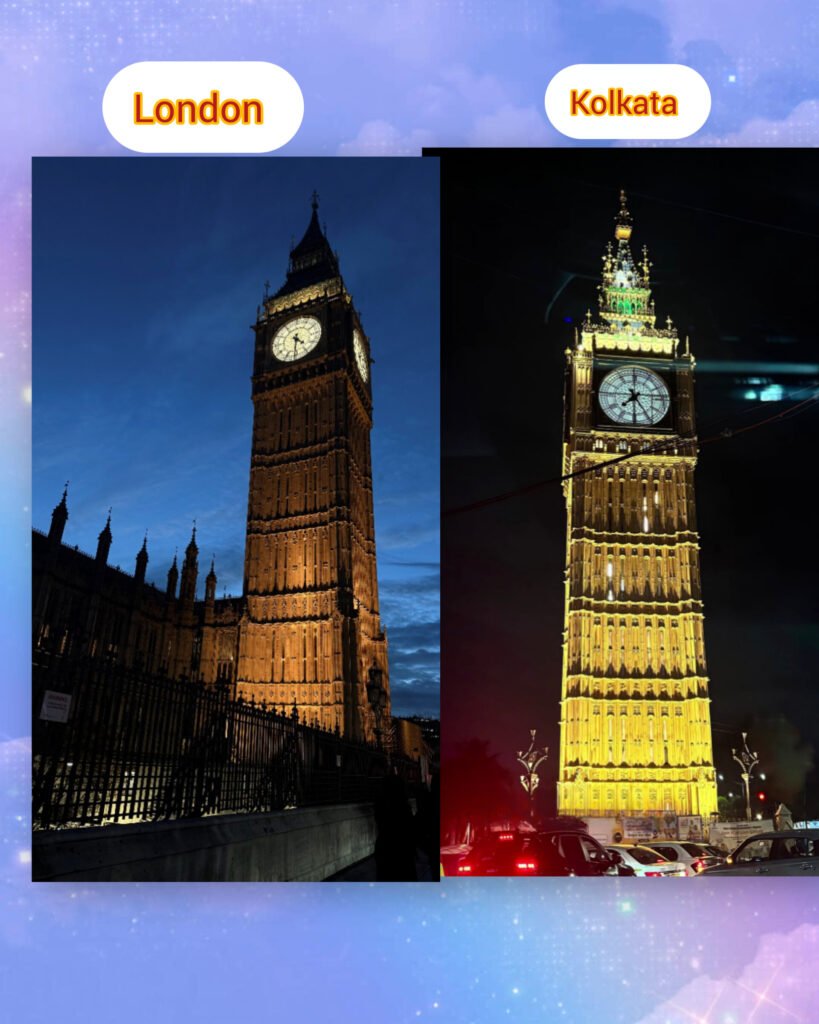
Here is a picture I took last year of the original Elizabeth Tower in London alongside a picture taken by my sister of the replica in Kolkata, which perhaps shows just how similar yet different this venture has been.There will, of course, always be obvious differences between the two cities.
London is an established global financial, political and cultural centre, with an enormous public transport network, extensive international connectivity and a level of economic activity which has developed over several centuries.
Kolkata, despite being one of India’s largest metropolitan cities and possessing its own considerable historical and cultural significance, continues to face a number of challenges relating to infrastructure, urban planning, congestion and public services.
If the objective of the comparison is therefore to make Kolkata more modern, more efficient and more internationally competitive, I believe Kolkata should absolutely aspire to hold itself to London’s standards if not better.
I say better, because the London Underground may be one of the world’s most recognisable transport networks, but my own experience has often involved delays, cancellations, engineering works and repeated Tube strikes. Having grown up using the Kolkata Metro, I have found myself appreciating its importance much more since moving to London.
Kolkata still has plenty of room for improvement, particularly in its roads, public spaces, waste management, pedestrian infrastructure and wider public transport system. These are areas where London can provide useful examples. However, modernising Kolkata should not mean losing what makes the city distinctive. Its culture, history, architecture, food, literature and political identity have developed over generations and remain central to the city’s character.
Kolkata should therefore learn from London’s strengths while avoiding its shortcomings, becoming a modern global city without losing what makes it Kolkata.This is why I do believe that Kolkata can become London, and it will. The ambition itself is not unrealistic if it is understood as a commitment to improving infrastructure, public transport, economic opportunity and the overall quality of urban life. What I question is whether London should be considered the final benchmark.
Having now lived in both cities, I have seen that London itself is far from perfect. If London provides a benchmark, then Kolkata should use it as a starting point rather than a ceiling, and if the objective is genuinely to create a better city for the people who live there, then Kolkata should not merely aim to become another London; it should aim to become a better one.
( Kolkata London of India, Secondary Keywords:, Kolkata can be London, Kolkata development, Kolkata infrastructure, Kolkata Metro vs London Underground,
Kolkata global city, Kolkata urban development, Kolkata smart city, Kolkata modernization, London vs Kolkata, Future of Kolkata)
2 Responses
I don’t know about London, but Kolkata needs to teach students more on practical knowledge rather than same old written exams . They should educate people to stop throwing garbages from the bus, train strict fine should be taken. More places should inaugurate like parks , fileds for childrens and also for adults because everyone wants a free space to sit observe children’s playing and laugh as because most of them live alone came here to build carriers
How can it be possible? Which govt department will do this? Share your idea